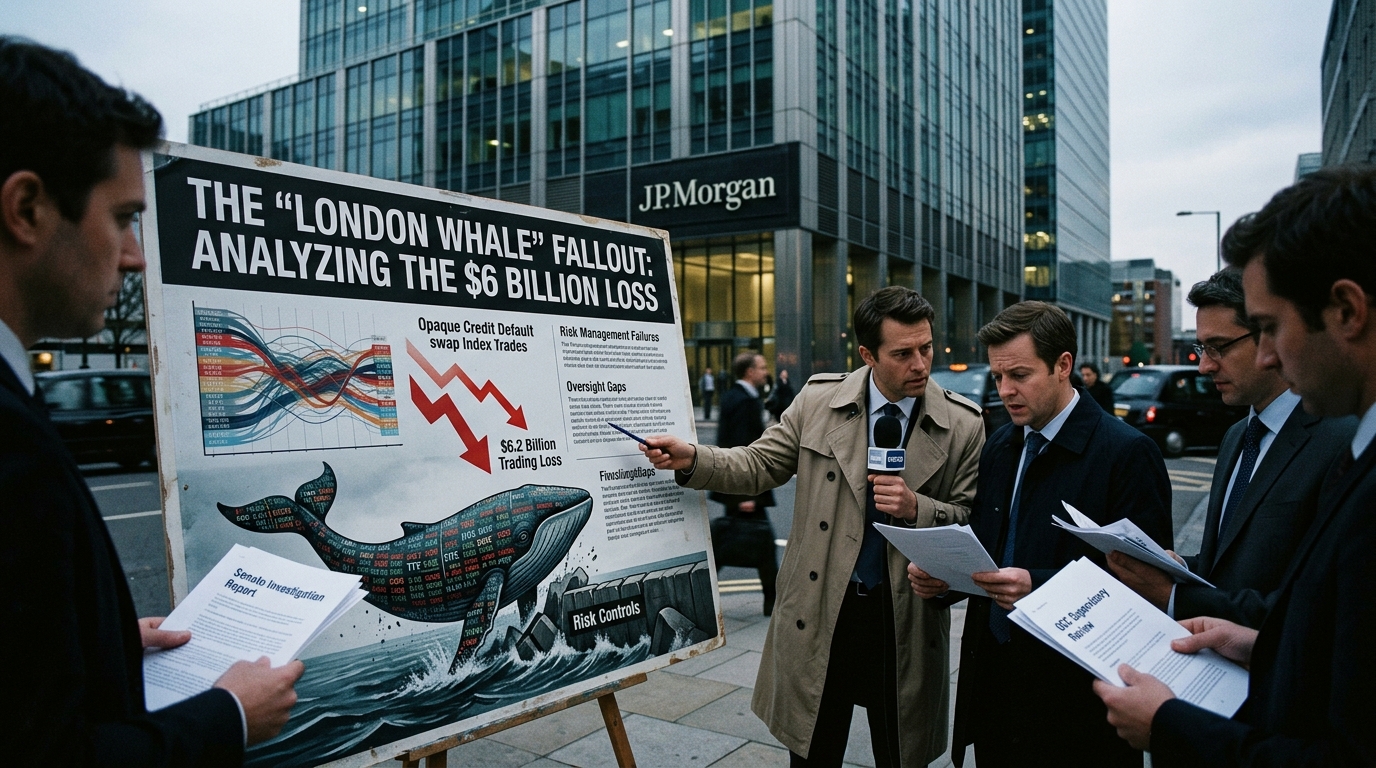
The “London Whale” Fallout: Analyzing the $6 Billion Trading Loss That Shook JPMorgan Chase
Introduction: When a Hedge Became a Catastrophe
In the world of high finance, risk management is supposed to be the shield that protects institutions from catastrophic losses. But what happens when the shield itself becomes the weapon? The London Whale scandal at JPMorgan Chase answers that question with a devastating price tag: $6 billion.
Nicknamed for the massive size of his trades, Bruno Iksil—a trader working in JPMorgan’s London-based Chief Investment Office (CIO) —orchestrated a credit derivatives strategy that was initially designed to hedge the bank’s exposure to European corporate debt. Instead, it spiraled into one of the largest trading debacles in modern banking history .
For the current-generation audience—including fintech professionals, retail traders, compliance officers, and investors who grew up in the post-2008 regulatory era—the London Whale episode is more than an old headline. It is a masterclass in oversight failure, a cautionary tale about complex financial instruments, and a case study that continues to influence banking regulations today.
This report dissects the opaque trades, the unanswered questions, and the lasting fallout from an event that forced even Jamie Dimon, one of Wall Street’s most respected CEOs, to admit it was “flawed, complex, poorly reviewed, poorly executed and poorly monitored” .
Section 1: The Making of a Whale – Understanding the Trades
Subheading: What Was the Chief Investment Office (CIO) Supposed to Do?
To understand the scandal, one must first understand the role of JPMorgan’s Chief Investment Office (CIO) . Unlike a traditional trading desk that seeks profit, the CIO was designed to manage the bank’s excess deposits and hedge its overall credit risk. In theory, this unit should be the safest, most conservative part of the bank.
However, in the years leading up to the incident, the CIO moved away from simple hedging. It began accumulating a massive synthetic credit portfolio (SCP) —a complex basket of credit default swaps (CDS) .
Subheading: The “Whale” Enters the Water
Bruno Iksil, nicknamed the “London Whale” due to the enormous volume of his trades, was the trader executing this strategy. His position was so large that it began to distort the credit derivatives market itself . Other market participants could see Iksil’s trades and began to trade against him, betting that JPMorgan’s massive exposure would eventually backfire.
Keyword Highlight: The core instruments were credit default swaps (CDS) , which function like insurance policies on corporate bonds. If a company defaults, the seller of the CDS pays the buyer. Iksil was selling this protection, effectively betting that a broad index of companies would remain solvent.
Subheading: A $100 Billion Bet on Stability
According to regulatory findings, Iksil built a $100 billion position—a bet that a specific basket of companies would remain “investment grade.” He became so confident that he disregarded standard hedging procedures. In fact, he sold CDS against his own position, effectively doubling down rather than protecting the bank .
When the market began to move against him in early 2012, the losses started small. Then they accelerated. The position proved impossible to unwind without moving the market against JPMorgan even further.
Section 2: The Anatomy of a Failure – What Went Wrong?
Subheading: Breakdown #1 – Position Sizing and Liquidity Miscalculation
The most fundamental error was position sizing. Iksil’s trades became so large that they were no longer flexible. In a liquid market, a trader can exit a position with minimal slippage. But because the London Whale was the market, any attempt to sell triggered a cascade of falling prices.
Keyword Highlight: Liquidity risk is often underestimated until it becomes critical. JPMorgan learned that a position too large to unwind is no longer a hedge—it is a trap .
Subheading: Breakdown #2 – Hedging That Was Not a Hedge
JPMorgan publicly defended the trades as a hedge against European credit risk. However, financial experts quickly noted that “Europe” is not a single security you can short. Hedging an entire continent’s volatile economy with a concentrated CDS position is not risk reduction—it is directional speculation .
As Marshall Sonenshine, a finance professor at Columbia University, wrote: “Derivatives are bets, and the word hedge does not mean safe” .
Subheading: Breakdown #3 – Risk Controls That Failed
Perhaps the most alarming failure was internal. When the CIO’s risk levels exceeded established limits, management did not unwind the trades. Instead, they changed the risk model. According to the UK’s Financial Conduct Authority (FCA) , traders were instructed to submit valuations “in a noticeably favourable manner” as losses mounted .
JPMorgan also kept critical information from regulators. The FCA noted that the bank ignored the regulator’s warning that its “appetite for further surprises was close to zero” .
Section 3: The Fallout – Fines, Admissions, and Criminal Charges
Subheading: The Financial Toll: $6 Billion and Climbing
Initially, CEO Jamie Dimon dismissed the growing problem as a “tempest in a teapot” during an earnings call . Within weeks, the estimated loss ballooned from $2 billion to over $6 billion. The final figure included not only trading losses but also massive legal settlements.
Subheading: Record-Breaking Regulatory Fines
Regulators on both sides of the Atlantic levied extraordinary penalties:
- $300 million to the U.S. Office of the Comptroller of the Currency (OCC)
- $200 million to the Federal Reserve
- $200 million to the U.S. Securities and Exchange Commission (SEC)
- £137.6 million ($219.7 million) to the UK’s Financial Conduct Authority (FCA)
The total fine approached $1 billion—an unprecedented sum that, adjusted for inflation, was one of the largest ever levied against a single bank at the time .
In an unusual move, the SEC also required JPMorgan to admit wrongdoing rather than settling with a “no-admit, no-deny” clause .
Subheading: Criminal Investigations and Individual Charges
While Bruno Iksil cooperated with federal prosecutors and reportedly avoided criminal charges, others were not so fortunate . Two JPMorgan employees faced serious legal consequences:
- Javier Martin-Artajo (Iksil’s supervisor)
- Julien Grout (the trader’s assistant)
Both were indicted on charges including conspiracy, wire fraud, and falsifying records to hide the mounting losses from the bank’s own internal systems . The FBI continued investigating whether additional senior executives should face prosecution, raising the stakes far beyond a simple financial penalty .
Section 4: Unanswered Questions and Lingering Criticisms
Subheading: Why Did Regulators Not See It Coming?
The London Whale scandal exposed a regulatory blind spot. JPMorgan had an army of internal risk officers and external regulators, yet none flagged the massive buildup in the CIO until it was too late.
Critics argue that regulatory capture played a role. Large banks wield enormous influence over the agencies meant to oversee them. As one analyst noted, the scandal revealed a systemic problem: “We rely too heavily on ‘structured’ systems to do our dirty work” .
Subheading: The Volcker Rule Controversy
The scandal erupted just as the Volcker Rule—a provision of the Dodd-Frank Act designed to prohibit banks from proprietary trading—was being finalized. JPMorgan’s lawyers argued that the CIO’s trades were legitimate hedges, not prohibited proprietary bets.
Critics disagreed. Columbia’s Sonenshine wrote: “What is marketed as risk management sometimes is merely risk inapt for financial institutions subsidized by public funds” . The episode delayed and complicated the implementation of post-2008 banking reforms.
Subheading: Was Compensation Ever Clawed Back?
The bank’s former Chief Investment Officer reportedly earned $15 million in compensation just before the $2 billion loss was revealed . Regulators reviewed whether executives should be forced to return pay under clawback provisions, but the outcome remained opaque . To this day, many believe that no senior executive truly faced personal financial consequences proportional to the damage.
Section 5: Lessons for Today’s Generation of Traders and Investors
Subheading: What Retail Traders Can Learn
You do not need a $6 billion loss to learn from the London Whale. The same principles apply to individual trading accounts:
- Position size is destiny. If one trade can wipe out your portfolio, it is too large .
- Liquidity is a mirage until you need it. Markets that look open can close against you instantly.
- Complexity is not sophistication. If you cannot explain your trade in one sentence, you should not be in it.
- Risk models are not reality. They rely on historical assumptions that fail during crises.
Subheading: Lessons for Compliance and Risk Management Professionals
For those working in financial compliance, the London Whale is a required case study in what not to do:
- Never adjust risk limits to fit the position. Change the position, not the limit.
- Valuation must be independent. Traders should never be allowed to mark their own books.
- Whistleblower channels must work. The fact that internal warnings went ignored is a systemic failure.
Keyword Highlight: The scandal led to permanent changes in banking supervision, including enhanced scrutiny of derivatives trading and mandatory stress testing for large positions.
Subheading: Relevance in the Current Financial Landscape
Decentralized finance, crypto trading, and algorithmic strategies have introduced new forms of risk, but the old lessons remain valid. The collapse of FTX, the Luna crash, and the near-failure of Archegos Capital all share DNA with the London Whale: excessive concentration, hidden leverage, and oversight failures.
As one commentator noted: “The days of the laughably small fine from the SEC appear to be over” . Regulators now demand admissions of guilt and multi-billion dollar penalties. But will that be enough to stop the next whale?
Conclusion: The Whale’s Echo
The London Whale scandal was not an accident of markets. It was a predictable outcome of weak internal controls, arrogant leadership, and complex instruments that outpaced the ability to manage them. JPMorgan survived—its balance sheet large enough to absorb the blow. But the reputation damage and regulatory fines left permanent scars.
For the current generation, the message is clear: No institution is too big to monitor. No hedge is too safe to blow up. Whether you are trading meme stocks, managing a crypto portfolio, or overseeing a corporate treasury, the lessons of 2012 remain urgent.
The whale has been harpooned. But the ocean is vast, and the next one may already be swimming beneath the surface.
Keywords: London Whale, JPMorgan trading loss, Bruno Iksil, credit default swaps, synthetic credit portfolio, risk management failure, Volcker Rule, banking regulations, derivatives scandal, and financial compliance.
https://www.videotat.com/category/mystery