The Wirecard Collapse: How €1.9 Billion Vanished in One of History’s Largest Accounting Frauds
Introduction: The Fintech Dream That Became a Nightmare
Once hailed as the crown jewel of European financial technology, Wirecard represented the future of digital payments. Based in Germany, it promised to revolutionize online transactions, challenging giants like Visa and Mastercard. Its market valuation soared higher than Deutsche Bank, making it a darling of investors and a symbol of modern, agile finance.
Then, everything unraveled.
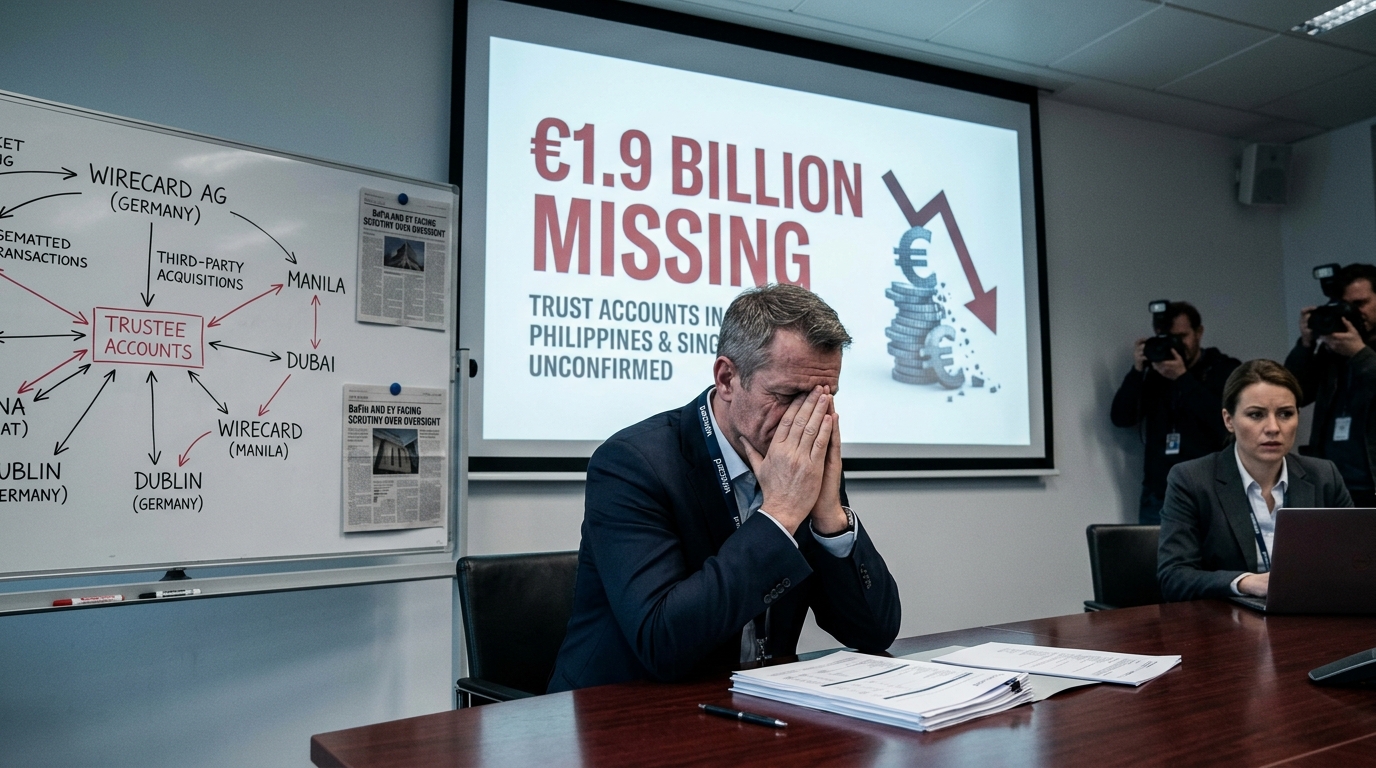
In a matter of weeks, €1.9 billion—cash that was supposed to be sitting in trustee accounts to protect merchants and customers—simply “disappeared.” Auditors could not find it. Executives denied its absence. Regulators looked the other way. When the truth finally emerged, it did not just expose a missing pile of money; it exposed a rotting core of international fraud, phantom revenues, and catastrophic regulatory failure.
This updated report deconstructs the scandal for a current-generation audience—investors, fintech founders, compliance officers, and everyday consumers—who need to understand how corporate deception can outsmart oversight in the digital age.
Section 1: The Rise of a Fintech Titan
How Wirecard Built an Empire on Digital Payments
Founded in the late 1990s, Wirecard began as a modest payment processor. However, it was during the online shopping boom and the explosion of e-commerce that the company found its footing. It offered merchant services, risk management, and card issuing for businesses large and small.
By the mid-2010s, Wirecard had become a global payments powerhouse, operating everywhere from Europe to Asia. Its leadership, particularly CEO Markus Braun, cultivated an image of a data-driven, high-tech innovator. The stock price reflected this hype—at its peak, Wirecard was valued at over €24 billion, larger than Germany’s second-largest bank, Commerzbank.
Key Appeal to Investors
- High-growth narrative: Wirecard claimed to process billions in transaction volume annually.
- Strategic acquisitions: The purchase of Indian payment firms and other fintechs signaled global ambition.
- Index inclusion: Wirecard joined Germany’s prestigious DAX 30 index, forcing passive funds to buy its shares.
For a generation raised on contactless payments and digital wallets, Wirecard seemed like the ultimate success story.
Section 2: The Cracks Begin to Show – Whistleblowers and Suspicions
Early Warnings Ignored by Regulators
Not everyone was fooled. For years, financial journalists and a small group of short-sellers questioned Wirecard’s accounts. The Financial Times (FT) published a series of explosive investigations, revealing:
- Falsified documents allegedly from Asian banks.
- Phantom revenue from third-party acquiring businesses.
- Unclear accounting in Singapore, Dubai, and the Philippines.
Yet, German regulators—most notably BaFin (Federal Financial Supervisory Authority)—did not protect investors. Instead, they launched a criminal complaint against the FT journalists and temporarily banned short selling of Wirecard shares. BaFin famously called the fraud allegations “market manipulation.”
Keyword highlight: This is a textbook example of regulatory capture and audit failure where the watchdog protected the watched.
The Role of a Singapore Shell Company
In 2018–2019, internal documents suggested that Wirecard’s Asian operations relied on a complex web of shell companies to book fake revenue. One key entity, a Singapore-based firm, supposedly held merchant contracts that generated hundreds of millions in fees. Investigators later discovered that these contracts did not exist.
Section 3: The Missing Billions – How €1.9 Billion Evaporated
The June 2020 Earthquake: A Scandal Breaks
On June 18, 2020, Wirecard’s auditor—EY (Ernst & Young)—announced that it could not locate €1.9 billion in cash. This amount represented roughly one-quarter of the company’s balance sheet. The funds were supposed to be held in trust accounts at two major Philippine banks—Bank of the Philippine Islands (BPI) and BDO Unibank.
When EY requested confirmation from the banks, the response was devastating: The accounts did not exist.
How the Fraud Worked in Practice
- Fake confirmation letters: Wirecard’s executives, including a senior manager in Dubai, allegedly forged bank documents.
- Round-tripping funds: Money was moved between real and fabricated accounts to give an illusion of solvency.
- Offshore obfuscation: Complex corporate structures in tax havens made tracing nearly impossible.
The €1.9 billion was never “missing.” It was never there to begin with.
Immediate Fallout
- Stock crash: Wirecard shares plunged by over 80% in days, then to zero.
- Insolvency filing: The company filed for insolvency on June 25, 2020.
- Arrests: CEO Markus Braun was arrested and later charged with fraud and market manipulation.
Section 4: The Global Web of Fraud and Enablers
Who Knew, and Who Looked Away?
This was not the work of a single rogue employee. Court documents and parliamentary inquiries revealed a coordinated international fraud network involving executives in Germany, Dubai, Singapore, and the United Kingdom.
Key Players and Their Roles
- Markus Braun (CEO): Allegedly directed the inflation of revenues and assets.
- Jan Marsalek (COO): The mysterious Austrian operative who orchestrated the fake Asian accounts and fled to Belarus/Russia.
- Third-party partners: Firms like a small UK-based payments company were used to funnel fake revenues.
Keyword highlight: The money trail led to offshore bank accounts, shell companies in Dubai, and secret side letters that never appeared in audited statements.
The Philippine Dimension
When the scandal broke, Philippine authorities confirmed that the supposed bank accounts had no records. Neither BPI nor BDO had any relationship with Wirecard. The “bank statements” were PDF forgeries created using stolen logos.
Section 5: Regulatory Failure – Why the Watchdogs Slept
BaFin’s Catastrophic Mismanagement
Perhaps more shocking than the fraud itself was the conduct of BaFin, Germany’s financial regulator. Instead of investigating Wirecard after the FT reports, BaFin:
- Opened a probe against the journalists.
- Banned short selling (which only delayed the inevitable).
- Publicly defended Wirecard’s management.
This behavior left a current-generation audience asking: If regulators protect criminals, who protects retail investors?
Lessons for Modern Compliance
- Reliance on management: Regulators mistakenly trusted Wirecard’s internal audits.
- Lack of cross-border cooperation: No one connected the dots between Singapore, Germany, and the Philippines.
- Audit limitations: EY relied on third-party confirmations without independently verifying bank accounts.
Section 6: Aftermath and Consequences – Justice Delayed?
Criminal Trials and Asset Recovery
Markus Braun remains on trial in Munich, facing charges of commercial gang fraud, embezzlement, and market manipulation. Prosecutors argue that Wirecard’s entire business model from 2015 onward was a Ponzi-like scheme—using new merchant revenue to cover up previous losses.
Jan Marsalek, the COO, remains a fugitive. Intelligence reports suggest he is hiding in Russia, possibly working with state-linked entities.
Investors have recovered little. Most of the €1.9 billion is gone. Litigation finance firms are now suing EY and former board members for negligence.
Impact on the Fintech Industry
The Wirecard collapse triggered a global reckoning:
- Stricter regulations in Europe (e.g., revised PSD2 oversight).
- Enhanced audit standards for non-bank financial firms.
- Greater scrutiny of offshore subsidiaries in fintech M&A.
For Gen Z and millennial investors, Wirecard became a cautionary tale: High growth does not equal transparency, and a DAX listing is not a safety certificate.
Section 7: Key Takeaways for Today’s Audience
What the Wirecard Scandal Teaches Us
- Never trust a single source of truth. Relying on management’s word or one auditor’s opinion is dangerous. Data triangulation and third-party verification are critical.
- Regulators can fail. BaFin’s behavior shows that even “reputable” watchdogs may have conflicts of interest or blind spots.
- Complex offshore structures = red flags. Any company with opaque subsidiaries in tax havens warrants deeper investigation.
- Whistleblowers are assets, not enemies. The Financial Times and short-sellers did what regulators should have done—asked hard questions.
- Modern investors must be detectives. Using tools like open-source intelligence (OSINT), corporate registry checks, and forensic accounting forums can reveal hidden risks.
Keywords for Search Engine Visibility
Throughout this analysis, key terms to note for professional reference include:
- Wirecard fraud
- €1.9 billion missing cash
- Accounting scandal
- Fintech collapse
- Regulatory failure BaFin
- Jan Marsalek fugitive
- Fake bank confirmations
- Audit negligence
- Corporate governance failures
- International money laundering
- Digital payment fraud
Conclusion: A Scandal for the Digital Age
The Wirecard “missing” billions did not vanish into thin air. They were never real. The fraud was not a magical disappearance—it was a deliberate, years-long fabrication that survived because no one powerful enough wanted to see it.
For today’s generation—digital natives, fintech employees, retail traders, and policymakers—the lessons remain urgent. Decentralized finance (DeFi) and crypto assets now promise transparency, but the same human weaknesses apply: greed, blind trust, and weak oversight.
The ghost of Wirecard haunts every boardroom where revenue growth is prioritized over reality. And until regulators, auditors, and investors learn to verify instead of trust, another Wirecard is likely already hiding in plain sight.
The Death of Gerald Cotten: The QuadrigaCX Mystery That Shook Cryptocurrency – VideoTAT