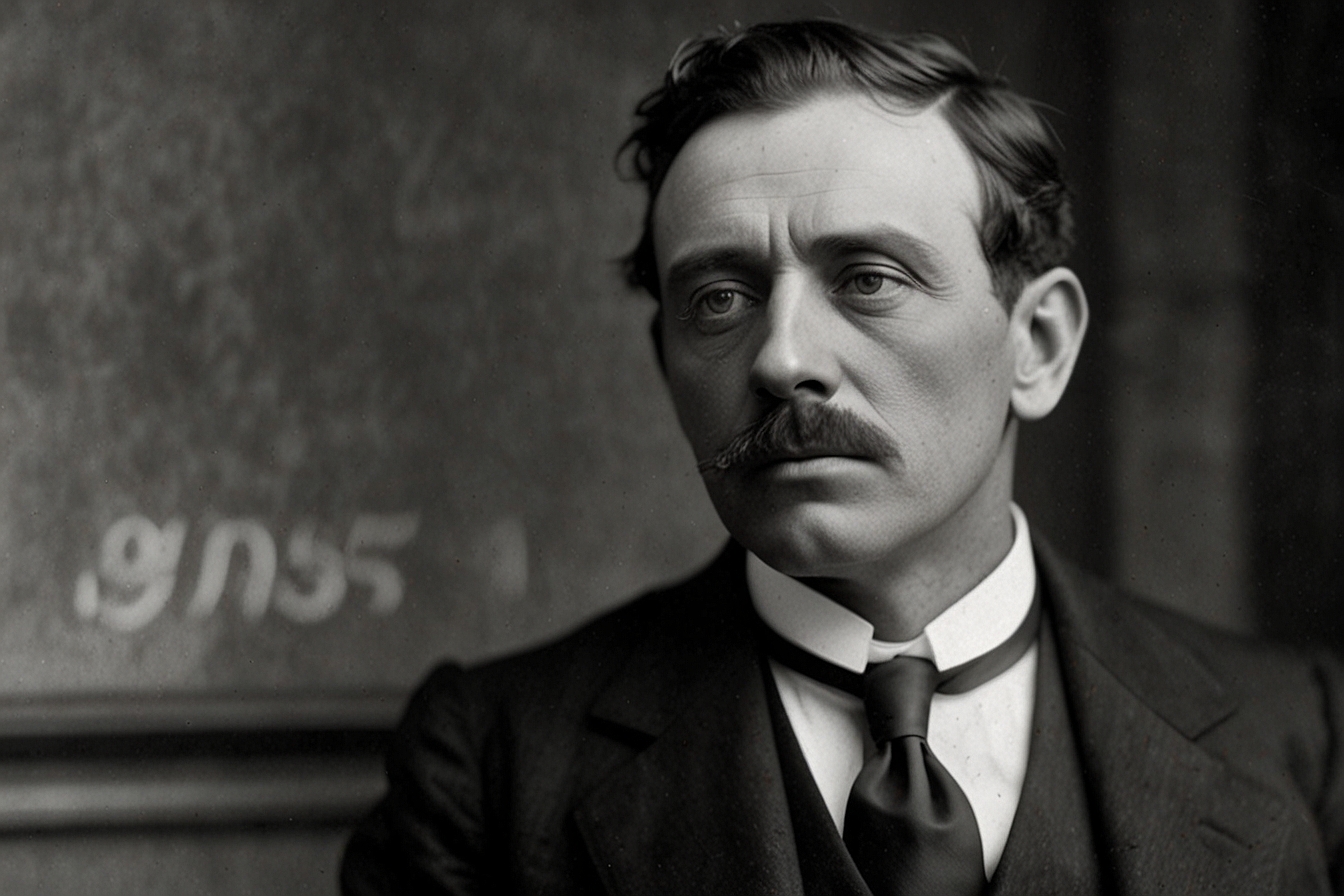
The Panic of 1907: How One Man Seized Control of a Crashing Economy
Introduction: When the Financial System Nearly Imploded
Imagine a world without a central bank—no Federal Reserve, no lender of last resort, no government safety net. In that world, a single rumor, a single failed bet, or a single bank run could bring the entire economy to its knees. This is exactly what happened during the Panic of 1907, a devastating financial crisis that pushed the United States to the brink of total collapse. At the moment of maximum chaos, there was no official institution to turn to. Instead, the country looked to one man: J.P. Morgan, the most powerful banker of his era.
Using his personal fortune, his unmatched reputation, and sheer force of will, Morgan acted as a one-man central bank, single-handedly stopping the meltdown. But his intervention raised a question that still haunts modern finance: Who really controls the money?
For today’s generation—raised on cryptocurrency, decentralized finance (DeFi) , and skepticism of centralized power—the Panic of 1907 offers a startling lesson. It shows how fragile the system can be and how unelected private individuals can hold life-or-death power over the global economy.
Key keywords highlighted: Panic of 1907, J.P. Morgan, one-man central bank, financial collapse, who controls the money, bank run, decentralized finance history.
Section 1: The Perfect Storm – What Sparked the Panic?
A Speculative Bubble Bursts
Before the panic, the U.S. economy had been growing at a breakneck pace, fueled by speculative investments in copper mining, railroads, and trust companies. These new-style financial firms operated with little oversight, offering higher returns than traditional banks but also taking much greater risks. In many ways, they resembled the shadow banking system of recent years—lending freely without adequate reserves.
The Failed Corner on Copper
The immediate trigger was an ambitious but reckless scheme by two speculators, F. Augustus Heinze and Charles W. Morse. They attempted to corner the copper market—buying so much of a single stock (United Copper) that they could manipulate its price. When the scheme failed spectacularly, the stock collapsed. Heinze and Morse controlled several banks and trust companies. As word spread, depositors panicked.
The First Domino Falls
Within days, a classic bank run began. Crowds formed outside financial institutions, desperate to withdraw their cash. Unlike today, there was no deposit insurance and no lender of last resort. Once a bank ran out of physical currency, it closed its doors—and every closure sparked more fear. The panic spread from New York to Chicago, Philadelphia to Boston.
Key keywords highlighted: speculative bubble, copper market, trust companies, shadow banking, bank run, deposit insurance, financial crisis trigger.
Section 2: J.P. Morgan – The Man Who Became a Central Bank
Who Was J.P. Morgan?
At the time, J.P. Morgan was not just a banker—he was an institution. His firm, J.P. Morgan & Co., financed the creation of U.S. Steel, General Electric, and major railroads. He had personally bailed out the U.S. Treasury a decade earlier. More importantly, he commanded the trust of every major financier in New York. When Morgan spoke, markets listened.
No Government Agency – One Man’s Office
Critically, there was no Federal Reserve to coordinate a response. No FDIC to guarantee deposits. No SEC to halt trading. The Treasury Department had limited funds and no clear authority to intervene. So Morgan did what he had always done: he took charge. He summoned the heads of the largest banks to his private library at 23rd Street and Madison Avenue in New York City. There, behind closed doors, he dictated terms.
The “Morgan Library” as a War Room
For weeks, Morgan’s library became the de facto financial command center. He locked the doors, forbade anyone from leaving until a solution was found, and personally decided which institutions would be saved and which would be allowed to fail. This was not democracy. It was private crisis management at its most extreme.
Key keywords highlighted: J.P. Morgan biography, private crisis management, no Federal Reserve, Morgan Library, financial command center, unelected power.
Section 3: How Morgan Stopped the Collapse – A Step-by-Step Intervention
Step 1: Injecting Liquidity
Morgan first ordered the major banks to pool their reserves and lend cash to struggling trust companies. He led by example, committing millions of his own firm’s money. This was the original bailout—private capital saving private institutions, long before the term existed.
Step 2: Saving the Trust Company of America
When the Trust Company of America faced a crushing run, Morgan demanded an audit. He told its president, “You are the man who is causing all this trouble. Go back to your office and do whatever is necessary.” Then he instructed other banks to keep lending. The run stopped—not because of government action, but because Morgan said it would.
Step 3: Rescuing New York City Itself
At the height of the crisis, New York City could not sell bonds to pay its workers. The city was hours from bankruptcy. Morgan organized a syndicate of bankers to buy the bonds instantly, providing emergency funding. In return, he demanded control over the city’s finance committee—an extraordinary private takeover of public finances.
Step 4: Forcing Bankers to Cooperate
One evening, Morgan gathered the heads of New York’s largest banks and locked the doors of his library until they agreed to a $25 million rescue package. Some bankers wept. Others threatened to leave. Morgan simply said: “Here is the plan. Sign.” They signed. This scene has become legendary: one unelected man, one locked room, one economy saved.
Key keywords highlighted: liquidity injection, bank bailout, Trust Company of America, emergency funding, locked room negotiation, private rescue package.
Section 4: The Aftermath – A Crisis Creates a Central Bank
The Immediate Victory
By late 1907, the panic subsided. Morgan had succeeded. The economy did not collapse. But the cost was clear: the financial system had been saved not by law, but by the whim of a single private citizen. Had Morgan been on vacation, or fallen ill, or simply refused to act, the country might have faced a depression years before the 1930s.
The Demand for Reform
The panic exposed a fatal flaw: no central bank meant no permanent mechanism to stop runs. Within a few years, the U.S. Congress passed the Federal Reserve Act, creating the central bank that exists today. The Fed was designed to do exactly what Morgan had done—act as lender of last resort—but as a public institution accountable to law, not to a single billionaire.
Did Anything Really Change?
Yet the questions raised by the Panic of 1907 remain disturbingly relevant. In the 2008 financial crisis, private bankers again met secretly at the New York Federal Reserve. In the COVID-19 market crash, emergency lending was deployed not by a single man but by a committee—still unelected, still largely opaque. And today, with the rise of Bitcoin, DeFi protocols, and self-custody wallets, a new generation asks: why trust any central authority, public or private, with control over money?
Key keywords highlighted: Federal Reserve Act, lender of last resort, 2008 financial crisis, COVID-19 market crash, Bitcoin, DeFi, self-custody, central bank creation.
Section 5: For the Current Generation – Lessons from 1907
Lesson 1: The Fragility of Trust
The Panic of 1907 was not caused by bad loans alone. It was caused by loss of confidence. When people stopped trusting that their bank would have cash, they rushed to withdraw it—making the prophecy self-fulfilling. In the age of social media virality, a single tweet or TikTok rumor can spark a digital bank run (as seen in recent crypto exchange failures). Trust remains the real currency.
Lesson 2: Centralization vs. Decentralization
Morgan’s intervention worked, but it terrified many Americans. One man controlled the fate of millions. That fear helped birth the Federal Reserve, a centralized institution. Today, the pendulum has swung the other way. Cryptocurrencies, blockchain, and DAO governance reject centralization entirely. The question from 1907—“Who really controls the money?”—is being answered anew by code, not by kings or bankers.
Lesson 3: The Return of Private Power
Ironically, private financial power is resurgent. Tech billionaires, crypto whales, and private equity firms now wield influence that rivals small nations. During the GameStop short squeeze and the Silver squeeze, retail traders coordinated online to challenge institutional power—exactly the kind of unpredictable shock that Morgan once managed behind locked doors.
Lesson 4: No System Is Safe Without Rules
The Panic of 1907 led to the Federal Reserve, but that did not prevent future crises. The lesson for today’s generation is simple: no system is foolproof. Whether you trust central banks, private billionaires, or decentralized networks, every financial system depends on human behavior. And human behavior is always one rumor away from panic.
Key keywords highlighted: digital bank run, crypto exchange failure, centralization vs decentralization, blockchain, DAO governance, GameStop short squeeze, retail traders, financial system rules.
Section 6: What If J.P. Morgan Existed Today?
The Modern Morgan
If a figure like J.P. Morgan existed now, he would not simply control banks. He would likely be the founder of a crypto exchange, a stablecoin issuer, and a private credit fund. He would host emergency summits in a virtual reality boardroom. He would deploy smart contracts to halt runs automatically. And he would still face the same fundamental question: why should one person have that much power?
Decentralized Alternatives
Today’s DeFi protocols use overcollateralized lending and automated liquidations to prevent bank runs without any central figure. But they have their own risks: code exploits, governance attacks, and sudden stablecoin de-pegs. No system—centralized or decentralized—has eliminated the possibility of panic.
The Unanswered Question
More than a century after the Panic of 1907, the question remains open: Who really controls the money? Is it central bankers? Private billionaires? Algorithmic protocols? Or the chaotic, unpredictable will of the crowd? The answer changes with every generation. But the question never goes away.
Key keywords highlighted: crypto exchange, stablecoin, smart contracts, DeFi protocols, overcollateralized lending, automated liquidations, stablecoin de-peg, algorithmic control.
Conclusion: A Crisis That Never Truly Ended
The Panic of 1907 was a turning point in financial history. It showed the world that without a central bank, economies are vulnerable to rumor and fear. It also showed that private power can save the system—but at the cost of democratic accountability. J.P. Morgan acted as a one-man central bank because no real one existed. Today, central banks do exist, yet crises still happen. And new technologies promise a future with no banks at all—central or otherwise.
For the current generation, the Panic of 1907 is not a dusty history lesson. It is a warning and an invitation. It warns that trust is fragile and that control over money is never truly settled. It invites us to build better systems—more transparent, more resilient, and more fair. But no matter what we build, the ghost of 1907 lingers: when the next panic arrives, who will be in the locked room? And who will hold the key?
Panic of 1907 summary, J.P. Morgan central bank, financial crisis lessons, who controls money today, history of bank runs, DeFi vs central banking, trust in finance.
https://www.youtube.com/@videotat-documentary
https://twitter.com/VideoTAT_docs
https://www.facebook.com/VideoTAT.1
https://www.pinterest.com/VideoTAT/