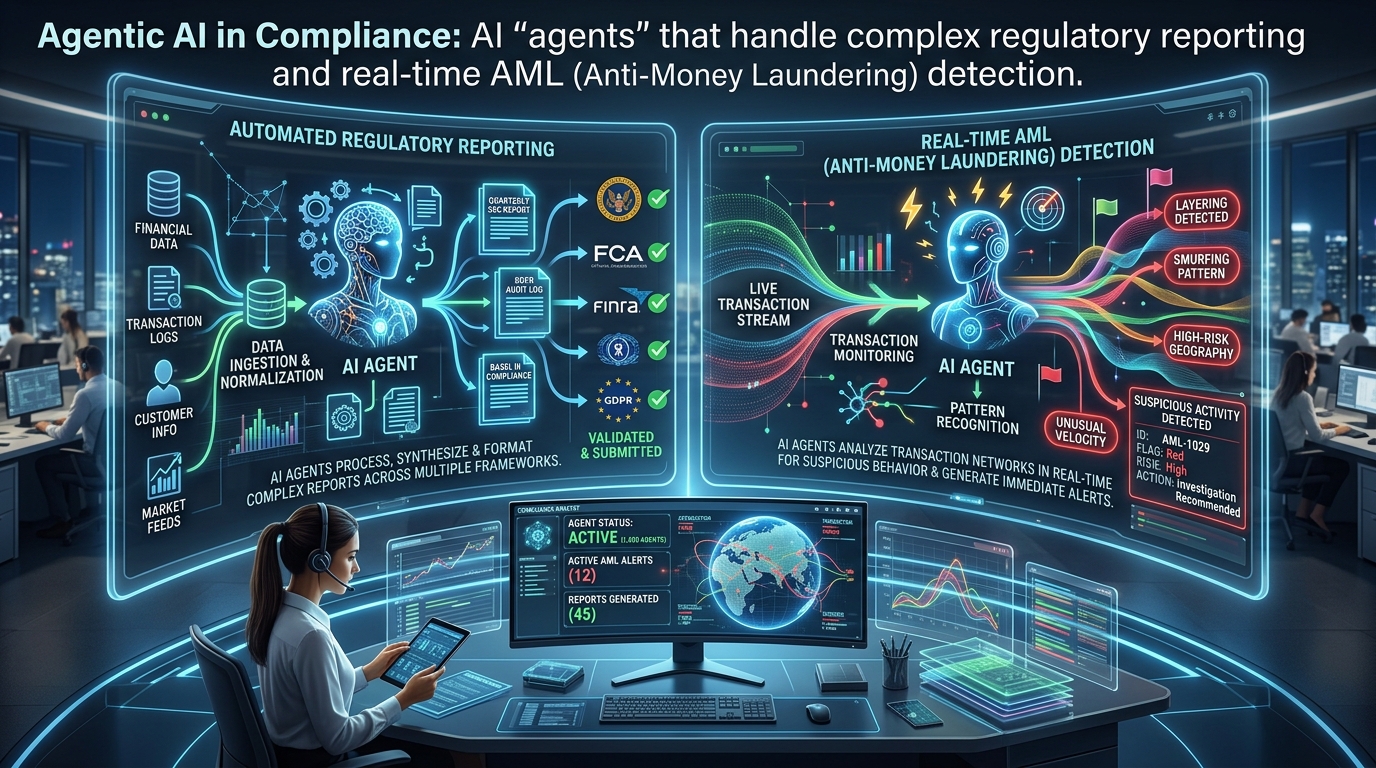
Agentic AI in Compliance: The Rise of Autonomous Regulatory Reporting and AML Detection
For years, financial compliance has been a reactive, labor-intensive burden. Teams of analysts manually sift through thousands of transactions, file regulatory reports after the fact, and chase down potential red alerts that often turn out to false positives. The process is slow, expensive, and increasingly ineffective against sophisticated financial crime.
That era is ending. A new generation of Agentic AI is transforming compliance from a rearview-mirror exercise into a real-time, intelligent, and autonomous shield. Unlike simple rule-based systems or passive machine learning models, Agentic AI uses autonomous AI agents that perceive, reason, and act—handling complex regulatory reporting and detecting money laundering as transactions happen, not hours or days later.
What Is Agentic AI? Moving Beyond Rules and Chatbots
Defining the Agentic Approach
An AI agent is not a chatbot. It is not a dashboard. It is an autonomous software entity with a goal, access to tools (databases, APIs, reporting systems), and the ability to take actions without human step-by-step instructions. In the compliance world, an agent might have the mission: “Ensure all suspicious activity is detected and reported within regulatory time limits while minimizing false positives.”
To accomplish this, the agent continuously monitors transaction streams, cross-references customer profiles, evaluates risk scores, and when necessary, drafts and files regulatory reports—all without a compliance officer clicking “approve” on every micro-decision.
Why Agentic AI Is Different from Traditional Automation
Traditional compliance automation follows fixed rules: “If transaction exceeds $10,000, file a Currency Transaction Report.” Criminals quickly learn to structure transactions just below the threshold. Machine learning improved detection by spotting patterns, but still required human review for most alerts.
Agentic AI combines the pattern recognition of ML with autonomous decision-making and adaptive planning. An agent can notice that a seemingly normal series of small deposits, when viewed across multiple accounts and geographies, forms a layering pattern typical of money laundering. It can then automatically escalate, file a Suspicious Activity Report (SAR) , and even adjust its own detection parameters for similar future patterns—all in real time.
Complex Regulatory Reporting: From Monthly Chore to Continuous Process
The Burden of Legacy Reporting
Regulatory reporting has traditionally been a batch process. Transactions accumulate. At end of day, week, or month, systems generate reports for agencies monitoring financial crime, market abuse, or sanctions violations. This delay creates a massive vulnerability: criminals can move funds, close accounts, and disappear before regulators ever see a report.
Moreover, the complexity of modern regulations—across multiple jurisdictions, each with different formats, thresholds, and timelines—overwhelms human teams. A single global bank may need to file dozens of report types, from SARs to CTRs to travel rule data for cryptocurrency transfers.
Agentic AI as a Continuous Reporting Engine
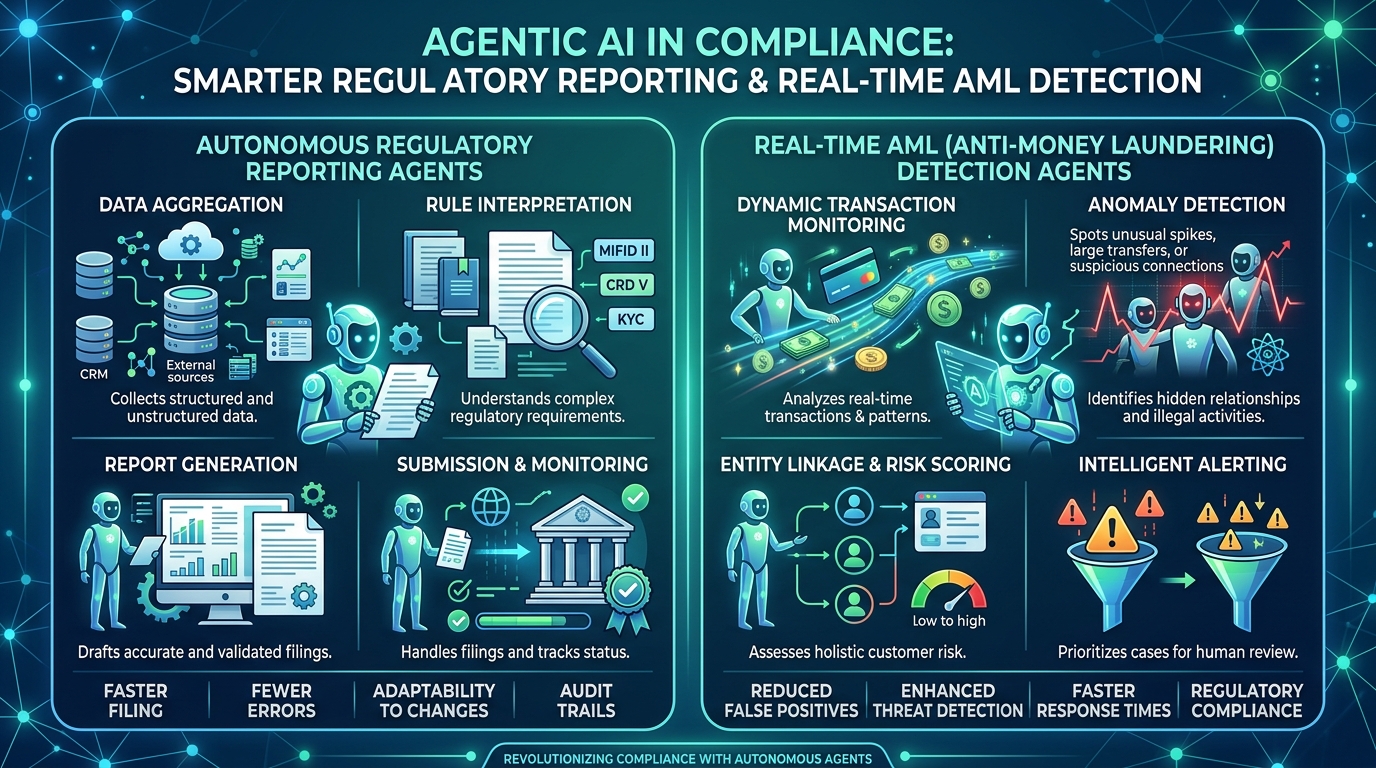
With Agentic AI, regulatory reporting becomes a continuous, event-driven process. Multiple specialized AI agents work in parallel:
- Monitoring agents watch every transaction in real time against internal and external watchlists.
- Assessment agents evaluate whether observed behavior meets the legal definition of “suspicious” based on current regulatory guidance (which they can ingest automatically when updated).
- Reporting agents format, populate, and submit reports to the correct agencies within required time windows.
If a customer suddenly sends three international wire transfers just under the reporting threshold, followed by a rapid account closure request, the agent swarm detects this as a coherent pattern—not three isolated events. It files a SAR within minutes, not weeks, and preserves all relevant evidence for investigators.
Real-Time AML Detection: Stopping Money Laundering as It Happens
The Failure of Traditional AML Systems
Traditional Anti-Money Laundering (AML) systems suffer from two fatal flaws: latency and noise. A transaction is approved, money moves, and hours later a batch job flags it as potentially suspicious. By then, funds have been withdrawn, converted to cryptocurrency, or moved offshore. Meanwhile, false positive rates often exceed 95%, meaning compliance teams waste thousands of hours chasing ghosts.
The current generation of financial criminals operates at digital speed—using instant payments, crypto mixers, and decentralized finance (DeFi) protocols. A compliance system that cannot keep up is not just inefficient; it is dangerous.
How Agentic AI Enables True Real-Time AML
Real-time AML detection requires an architecture where analysis and action happen within the transaction approval window—often under 500 milliseconds. Agentic AI achieves this through:
- Parallel agent swarms: Instead of a single model evaluating each transaction, specialized agents check different risk dimensions simultaneously. One agent analyzes counterparty risk. Another evaluates geographic velocity. A third checks for structured deposits across related accounts.
- Memory and context: Unlike one-off models, agents maintain temporal memory. They remember that a customer who has never sent cross-border payments suddenly initiated three this week. They connect this with a recent change in beneficial ownership.
- Autonomous escalation: When confidence crosses a threshold, an agent can freeze a transaction, require additional verification (e.g., a biometric confirmation), or automatically file a report—all without human waiting time.
How AI Agents Collaborate: The Swarm Intelligence Model
Specialized Agents for Different Compliance Domains
No single AI can master every aspect of compliance. Instead, Agentic AI systems deploy a swarm of specialized agents, each with its own role:
| Agent Type | Primary Function |
|---|---|
| Transaction Monitoring Agent | Scans every payment for velocity, amount, and counterparty anomalies |
| Customer Risk Agent | Maintains dynamic risk scores based on behavior, not static categories |
| Sanctions Screening Agent | Checks names, addresses, and corporate registrations against global watchlists |
| Reporting Agent | Formats and files regulatory documents across jurisdictions |
| Investigator Support Agent | Assembles evidence packages for human review when required |
These agents communicate and negotiate. If the Sanctions Screening Agent finds a partial name match (e.g., “A. Smith” on a watchlist), it asks the Transaction Monitoring Agent for recent activity patterns before deciding whether to block or release.
Human-in-the-Loop Without Bottlenecks
Fully autonomous compliance raises valid concerns about accountability. Responsible Agentic AI systems therefore implement intelligent human-in-the-loop workflows:
- Low-confidence alerts are automatically resolved by agents (e.g., false positives dismissed with an audit trail).
- Medium-confidence alerts trigger a notification to a human compliance officer, with the agent’s reasoning attached.
- High-confidence, high-risk events (e.g., suspected terrorist financing) trigger immediate automated actions (freeze, report), with mandatory human review within hours.
This hybrid model preserves speed while maintaining regulatory compliance and legal defensibility.
Real-World Scenarios: Agentic AI in Action
Scenario A: Cryptocurrency Exchange Compliance
A global crypto exchange faces intense pressure to prevent money laundering while maintaining instant withdrawals. A user deposits funds from a regulated exchange, then attempts to withdraw to a known privacy wallet associated with mixing services.
Legacy system: The transaction would likely be approved, since the deposit source appeared clean. Investigation would happen after the fact—too late.
Agentic AI response:
- The Transaction Monitoring Agent flags the withdrawal destination as high risk.
- The Customer Risk Agent notes that this user has never used a privacy wallet before.
- The Swarm collectively decides to pause the withdrawal, request identity verification, and notify the compliance team.
- Within 90 seconds, the user is asked to verify source of funds. If they fail, the Reporting Agent files a SAR and the account is restricted.
Scenario B: Cross-Border SME Payments
A small business that typically imports goods from one country suddenly starts sending payments to multiple new jurisdictions. Legacy AML would see each payment individually and likely clear them.
Agentic AI detects the pattern across 15 payments over three days. The Sanctions Screening Agent finds that one of the new counterparties is on a secondary sanctions list. The swarm:
- Automatically files a regulatory report noting the pattern.
- Places a temporary hold on further payments.
- Sends a plain-language alert to the business owner: “We’ve noticed a change in your payment destinations. Please confirm these are legitimate supplier changes.”
- If confirmed, the agents update the customer’s profile and release future payments. If not, the case escalates.
The Technology Behind Agentic AI Compliance
Large Language Models for Regulatory Understanding
Modern Agentic AI systems leverage large language models (LLMs) fine-tuned on regulatory text. These models can ingest new guidance from FinCEN, OFAC, or local financial intelligence units and immediately adjust agent behavior. No need to rewrite code or wait for vendor updates.
Graph Neural Networks for Relationship Mapping
Money laundering almost always involves networks of accounts and entities. Graph neural networks allow agents to see hidden connections—a payment from A to B, then B to C, then C back to A—that suggest layering or shell activity. Agents can explore this transaction graph autonomously, following chains without human queries.
Federated Learning for Cross-Institution Privacy
Banks and fintechs cannot easily share customer data due to privacy laws. Federated learning enables agents to learn patterns of money laundering across institutions without moving raw data. A model might learn that “rapid account funding followed by immediate offshore transfer” is a universal red flag, and deploy that knowledge everywhere without exposing any single bank’s transactions.
Why Current-Generation Compliance Teams Are Adopting Agentic AI
The Talent Shortage and Burnout Crisis
Compliance hiring has exploded, yet burnout rates remain high. Analysts spend 80% of their time on false positives and manual data entry. Agentic AI liberates them to focus on genuine complex cases, strategic improvements, and regulator relationships.
Regulators Are Demanding Speed and Accuracy
Financial intelligence units worldwide now expect real-time or near-real-time reporting for certain transaction types. Banks still filing batch reports after 30 days face fines and public censure. Agentic AI systems are the only practical way to meet these expectations at scale.
The Rise of Instant Payment Systems
Real-time payment rails (domestic and international) settle in seconds. A compliance system that takes minutes is irrelevant. Agentic AI operates at the same speed as the payments it monitors, closing the window for criminal exploitation.
Getting Started with Agentic AI in Compliance
Step 1: Identify High-Volume, High-False-Positive Areas
Start with the pain points: transaction monitoring for retail banking, sanctions screening for cross-border payments, or SAR filing for wealth management. These are ideal candidates for autonomous agents.
Step 2: Run Agentic AI Alongside Legacy Systems
Do not rip and replace. Run agents in shadow mode—analyzing transactions, making decisions, but not yet acting. Compare their performance to human teams on speed, false positive reduction, and detection rate. Once confidence exceeds a threshold, grant limited autonomy (e.g., auto-dismiss clearly false positives).
Step 3: Build Explainability into Every Agent
Regulators will ask, “Why did the agent make that decision?” Ensure your agents produce auditable rationales—not just a confidence score, but a human-readable explanation referencing specific rules, patterns, or historical data. Some agents can even generate draft narrative sections for SARs that an officer simply reviews and signs.
Step 4: Establish Clear Human Oversight Protocols
Define exactly when an agent must pause and wait for a human (e.g., any action affecting a politically exposed person) versus when it can act independently (e.g., dismissing a low-value, low-risk false positive). Document these protocols as part of your compliance program.
Conclusion: The Autonomous Future of Financial Compliance
Agentic AI is not a distant promise. It is already transforming how forward-looking institutions handle regulatory reporting and real-time AML detection. By deploying autonomous AI agents that perceive, reason, and act across transaction streams, compliance teams can finally escape the trap of latency, noise, and manual drudgery.
For the current generation of digital-native consumers and regulators alike, the expectation is clear: financial crime should be stopped as it happens, not discovered weeks later. And compliance should be a competitive advantage—fast, accurate, and transparent—not a cost center that slows everything down.
Agentic AI delivers on that promise. The agents are ready. The question is whether your compliance function is ready to trust them.