Hyper-Personalized Wealth Management: How AI-Driven Financial Co-Pilots Democratize Bespoke Investing
For generations, elite wealth management was a privilege reserved for the few. High-net-worth individuals enjoyed dedicated advisors, bespoke portfolio strategies, tax optimization, and estate planning. Everyone else received one-size-fits-all products: the same mutual funds, the same retirement targets, the same generic advice. The gap between the wealthy and everyone else was not just about money—it was about access to intelligence.
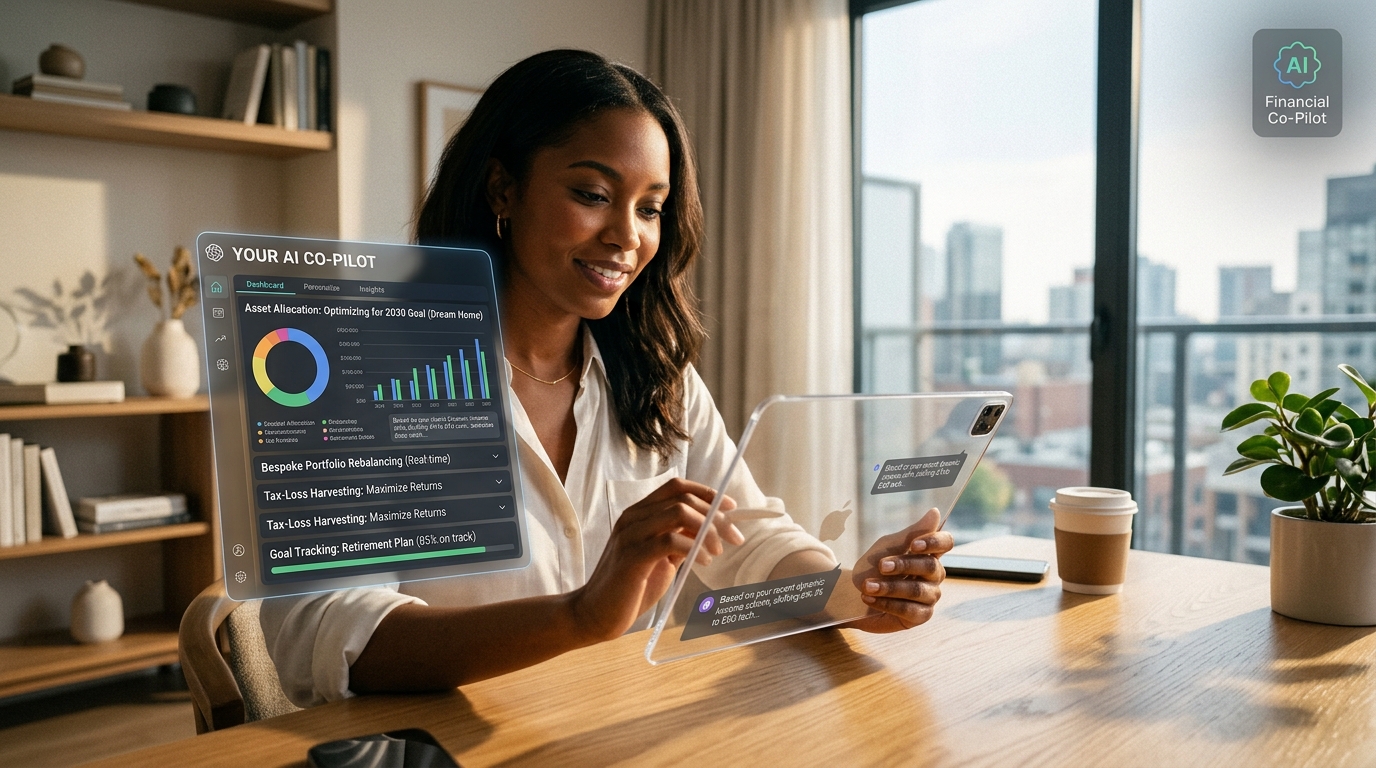
That wall is crumbling. Hyper-personalized wealth management is now a reality for the mass market, thanks to AI-driven financial co-pilots. These intelligent systems deliver bespoke investment advice—previously reserved for private banking clients—to anyone with a smartphone and a brokerage account. From customized asset allocation to tax-loss harvesting, from goal-based planning to real-time risk adjustment, AI co-pilots are democratizing the very essence of elite finance.
What Is Hyper-Personalized Wealth Management? Beyond Robo-Advisors
The Limitations of First-Generation Robo-Advisors
Early robo-advisors were an important step forward, but they were not truly personalized. A typical robo-advisor asked a handful of questions: age, income, risk tolerance (on a 1–10 scale), and investment goal. It then placed you into one of a handful of pre-built portfolios. A 28-year-old in New York and a 28-year-old in rural Texas with the same risk score received identical allocations.
This approach ignored thousands of variables that matter: tax situation, liquidity needs, human capital (future earning potential), existing debt, family obligations, housing status, and even personal values like environmental concerns or ethical investing preferences.
Enter the AI-Driven Financial Co-Pilot
An AI-driven financial co-pilot is not a questionnaire. It is a continuous, learning, conversational partner embedded in your wealth management app. It observes your financial behavior, understands your goals in natural language, monitors market conditions in real time, and delivers bespoke investment advice tailored to your unique life—not to an average.
Unlike a human advisor who might meet you quarterly, your AI co-pilot is always on. It notices when your spending spikes, when you receive a bonus, when you change jobs, or when your risk preferences evolve. And it adapts your wealth strategy accordingly, instantly and intelligently.
From One-Size-Fits-All to Truly Bespoke Advice
The Data Advantage: What AI Knows About You
Traditional wealth managers work with what you tell them. AI co-pilots work with what you show them—often without realizing it. By integrating with your financial accounts, spending patterns, income streams, and even calendar (for major life events), the system builds a multidimensional model of your financial life.
Key data layers include:
- Cash flow dynamics (not just balance, but timing and volatility)
- Liability structure (mortgage, student loans, credit card debt with varying rates)
- Tax profile (bracket, state, deductible expenses)
- Life stage and trajectory (early career, mid-career with dependents, pre-retirement)
- Behavioral biases (loss aversion, overconfidence, recency bias inferred from past actions)
- Values and preferences (ESG, faith-based investing, community focus)
With these inputs, the AI co-pilot constructs an investment strategy as unique as a fingerprint.
Bespoke Asset Allocation: Not Just Stocks and Bonds
Generic advice might suggest “60% stocks, 40% bonds” for someone your age. Bespoke investment advice goes far deeper. Your AI co-pilot considers:
- Human capital: Are you a tenured professor (stable income, bond-like) or a startup founder (volatile income, equity-like)? Your portfolio should offset your human capital risk.
- Liquidity tiers: Money needed in six months (cash), three years (short-term bonds), ten-plus years (equities and alternatives).
- Tax-aware placement: High-yield bonds in tax-deferred accounts, growth stocks in taxable accounts.
- Concentration risk: If you work for Big Tech, your AI co-pilot reduces tech exposure in your portfolio.
- Real assets: Recommendations on whether to consider direct real estate, REITs, or commodities based on your local housing market.
No pre-built model portfolio can capture this complexity. Only an AI analyzing your full context can.
AI-Driven Financial Co-Pilots in Action: Core Capabilities
Continuous Goal Tracking and Rebalancing
Traditional rebalancing happens quarterly or annually. Your AI co-pilot rebalances continuously—but only when it makes sense. It monitors market drift, tax consequences, and transaction costs. For a small portfolio, it might allow wider bands before rebalancing to avoid fee erosion. For a larger portfolio, it rebalances opportunistically, even harvesting tax losses along the way.
Goal tracking is equally dynamic. If you tell your co-pilot, “I want to buy a house in three years,” it builds a dedicated sub-portfolio with appropriate risk and liquidity. If home prices in your area rise faster than expected, the system adjusts savings recommendations automatically. If you change your mind (“Actually, let’s wait five years”), the co-pilot re-optimizes instantly.
Tax Optimization at Scale
Tax-efficient investing was once the domain of private wealth clients with dedicated CPAs. AI co-pilots bring sophisticated tax optimization to everyone. Capabilities include:
- Automated tax-loss harvesting: Selling losing positions to offset capital gains, even in small accounts, without triggering wash sales.
- Asset location optimization: Placing high-tax investments in retirement accounts and tax-efficient investments in taxable accounts.
- Withdrawal sequencing: In retirement, recommending which accounts to draw from first (taxable, then tax-deferred, then tax-free) to minimize lifetime taxes.
- Charitable giving integration: Suggesting appreciated stock donations instead of cash for tax-conscious donors.
These strategies are not generic rules. They are personalized to your marginal tax rate, state of residence, and projected future income.
Dynamic Risk Management
Your risk tolerance is not static. It changes with market conditions, life events, and even news cycles. Your AI co-pilot monitors your behavior for signs of risk aversion or appetite. If you check your portfolio 20 times during a market dip, the system might infer anxiety and recommend a slightly more conservative glide path—or simply provide reassurance through conversational explanation.
Conversely, if you consistently ignore market volatility and maintain contributions through downturns, the co-pilot might gradually increase equity exposure, knowing you have the temperament to stay the course.
Bespoke Investment Advice for Specific Life Stages
The Early-Career Professional
A recent graduate with student loans, modest savings, and decades until retirement needs a fundamentally different strategy than a retiree. An AI co-pilot for this user might:
- Recommend prioritizing high-interest debt reduction before aggressive investing.
- Suggest a Roth IRA over traditional given likely future income growth.
- Use a higher equity allocation but with factor tilts (value, small-cap) suitable for long horizons.
- Automate savings increases after each pay raise (behavioral nudges).
- Provide educational content on compound interest, dollar-cost averaging, and emergency funds—all personalized to their actual spending patterns.
The Mid-Career Accumulator with Dependents
This user faces competing priorities: college savings, retirement, mortgage, aging parents. A generic robo-advisor might simply recommend “increase savings rate.” An AI co-pilot builds a multi-goal plan:
- Slices the portfolio into mental accounts: College (529 plan, moderate risk, 10-year horizon), Retirement (aggressive growth, 25-year horizon), Emergency Fund (cash, immediate).
- Optimizes across accounts: Holds bonds in the 529 (shorter horizon), stocks in retirement (longer horizon).
- Models tax trade-offs: 529 contributions (state tax deduction) vs. Roth IRA (flexibility).
- Adjusts automatically when a child gets a scholarship or when an aging parent needs financial support.
The Pre-Retiree and Retiree
Sequence-of-returns risk—the danger of a market crash just before or after retirement—is the single greatest threat to a retiree’s portfolio. An AI co-pilot manages this through:
- Glide path personalization: Not a fixed age-based formula, but a dynamic adjustment based on portfolio size relative to goal, market valuations, and spending flexibility.
- Income flooring: Recommendations for annuities, bond ladders, or dividend portfolios based on guaranteed spending needs.
- Required minimum distribution (RMD) planning: Projecting RMDs years in advance to manage tax spikes.
- Long-term care and legacy goals: Integrating insurance recommendations and gifting strategies.
Why the Current Generation Demands Hyper-Personalized Wealth Management
The Rejection of Average Advice
Today’s investors have grown up with hyper-personalization everywhere. Streaming services recommend individual songs. E-commerce shows products you actually want. Social media feeds are uniquely yours. Against this backdrop, generic investment advice feels insulting. “You are in the moderate growth portfolio” is not personalization—it is a category.
The current generation expects their wealth management to be as tailored as their playlist. AI-driven financial co-pilots deliver exactly that.
The Rise of Values-Based Investing
Millions of investors no longer want to maximize returns at any cost. They want their money to reflect their values: climate action, social justice, corporate governance, religious principles. Generic ESG funds are a start, but true bespoke investment advice goes further. An AI co-pilot can:
- Screen out specific companies or industries based on your stated values.
- Overweight positive-impact investments (green bonds, community development funds).
- Measure and report your portfolio’s carbon footprint or diversity metrics.
- Balance values against return and risk, showing trade-offs clearly.
No human advisor could do this at scale for thousands of clients. An AI co-pilot can.
Financial Literacy and Transparency
The current generation is skeptical of opaque fee structures and “black box” advice. They want to understand why a recommendation is made. AI co-pilots provide explainability by default: “I am recommending a 70/30 stock/bond split because your retirement is 30 years away, your job is stable, and you have no high-interest debt. Here is how a different allocation would have performed historically.”
This transparency builds trust and financial literacy simultaneously.
Real-World Scenarios: Hyper-Personalized Wealth Management in Action
Scenario A: The Climate-Conscious Tech Worker
Jordan earns $180,000 as a software engineer, rents an apartment, has no debt, and wants to retire early while minimizing environmental harm. Jordan’s AI co-pilot:
- Analyzes spending and recommends maxing out the 401(k) up to the employer match, then funding a Roth IRA.
- Builds a portfolio with 80% equities, 20% bonds. Equities exclude fossil fuels, mining, and deforestation-linked companies. Bonds include green bonds and community development instruments.
- Projects a retirement age of 52 based on current savings rate, but offers an interactive slider: “Reduce emissions intensity by 30%? That would delay retirement by 14 months.”
- Auto-rebalances monthly and donates tax-loss harvesting savings to an environmental nonprofit per Jordan’s standing instruction.
Scenario B: The Sandwich Generation Caregiver
Patricia is 45, has two teenagers, and recently moved her aging mother into an attached suite. She earns $120,000 but faces new caregiving expenses. Her AI co-pilot:
- Detects increased spending on medical supplies and home modifications.
- Re-runs cash flow projections and identifies a potential shortfall in retirement savings.
- Recommends reducing 529 contributions temporarily (college is eight years away) while maintaining retirement contributions.
- Suggests a Health Savings Account (HSA) for qualified medical expenses, with investment options for unused balances.
- Flags a tax credit for dependent care that Patricia was unaware of, based on her transaction data.
Patricia’s plan updates automatically, and the co-pilot explains each change in plain English.
The Technology Behind AI-Driven Financial Co-Pilots
Large Language Models for Natural Interaction
Unlike menu-driven apps, modern co-pilots use large language models (LLMs) to converse naturally. You can type or speak: “I’m nervous about the market. Should I move to cash?” The LLM understands the emotion, retrieves relevant portfolio data, and responds with both reassurance and analysis: “Market volatility is normal. Your portfolio is diversified across sectors. Moving to cash would lock in recent losses. However, let’s review your risk tolerance setting—would you like to adjust it slightly?”
Multi-Agent Architectures
Financial co-pilots often use multiple specialized AI agents working together:
| Agent | Function |
|---|---|
| Data Aggregator | Connects to accounts, normalizes transactions, detects changes |
| Goal Tracker | Monitors progress toward each goal, flags deviations |
| Portfolio Optimizer | Runs asset allocation models, tax calculations, rebalancing scenarios |
| Risk Manager | Monitors volatility, drawdowns, and behavioral signals |
| Conversational Agent | Handles user questions, explains recommendations, takes instructions |
These agents share a unified understanding of your financial life but divide complex tasks for speed and reliability.
Privacy and Security Architecture
Wealth management data is extremely sensitive. Responsible AI co-pilots use:
- End-to-end encryption for all data in transit and at rest.
- Local processing where possible (personally identifiable information never leaves your device).
- Transparent data policies: You own your data, and the AI co-pilot cannot share it without explicit permission.
- Read-only access: The system can recommend trades but cannot execute them without your approval (though you can grant execution权限 if desired).
Challenges and Responsible Implementation
Avoiding Algorithmic Herding
If millions of investors use similar AI co-pilots, could they all rush for the exits simultaneously during a market downturn? Responsible systems incorporate circuit breakers and diversification across models to avoid herding behavior. Your co-pilot might say: “Many others are reducing risk, but given your specific goals and time horizon, staying the course remains optimal.”
Managing Over-Personalization
There is a risk of creating “filter bubbles” in investing, where you only see opportunities aligned with your existing biases. Good AI co-pilots occasionally introduce contrarian viewpoints: “You have no international exposure. Here is how adding developed market equities would have improved returns in three of the last five recessions.”
The Human Touch
AI co-pilots are powerful, but they are not human. For complex life decisions (divorce, inheritance, business sale), the best systems recommend consulting a human advisor, lawyer, or accountant. The goal is augmentation, not replacement.
Getting Started with an AI-Driven Financial Co-Pilot
For Investors: What to Look For
When choosing a wealth management platform with an AI co-pilot, look for:
- Deep integration with your bank accounts, credit cards, and investment accounts (not just manual entry).
- Natural language interface (not just multiple-choice forms).
- Transparent fee structure (no hidden commissions or revenue-sharing).
- Explainability (the system should tell you why it recommends something).
- Control (you can override, pause, or adjust any automation).
For Wealth Managers: The Competitive Imperative
Firms that do not offer hyper-personalized, AI-driven advice will lose mass-affluent clients to fintechs and neobrokers. The path forward includes:
- Augmenting human advisors with AI co-pilots that handle routine rebalancing, tax harvesting, and reporting.
- Offering a direct-to-consumer AI co-pilot for smaller accounts that cannot justify a dedicated human.
- Building or buying LLM-based conversational and analytical capabilities.
Conclusion: The End of Financial Elitism
Hyper-personalized wealth management powered by AI-driven financial co-pilots is not a luxury feature. It is the new baseline. The same technology that once required a private banking relationship and a seven-figure account balance is now available to anyone with a smartphone and a desire to build wealth intelligently.
Bespoke investment advice—tailored to your cash flow, your values, your tax situation, your life stage, and your risk psychology—is no longer reserved for the few. It is being democratized, in real time, by AI that works tirelessly in your favor.
The current generation does not need to inherit wealth to invest like the wealthy. They just need the right co-pilot. And that co-pilot has finally arrived.
youtube.com/@videotat-documentary
The Confederate Treasury: America’s Most Enduring Lost Treasure Mystery – VideoTAT