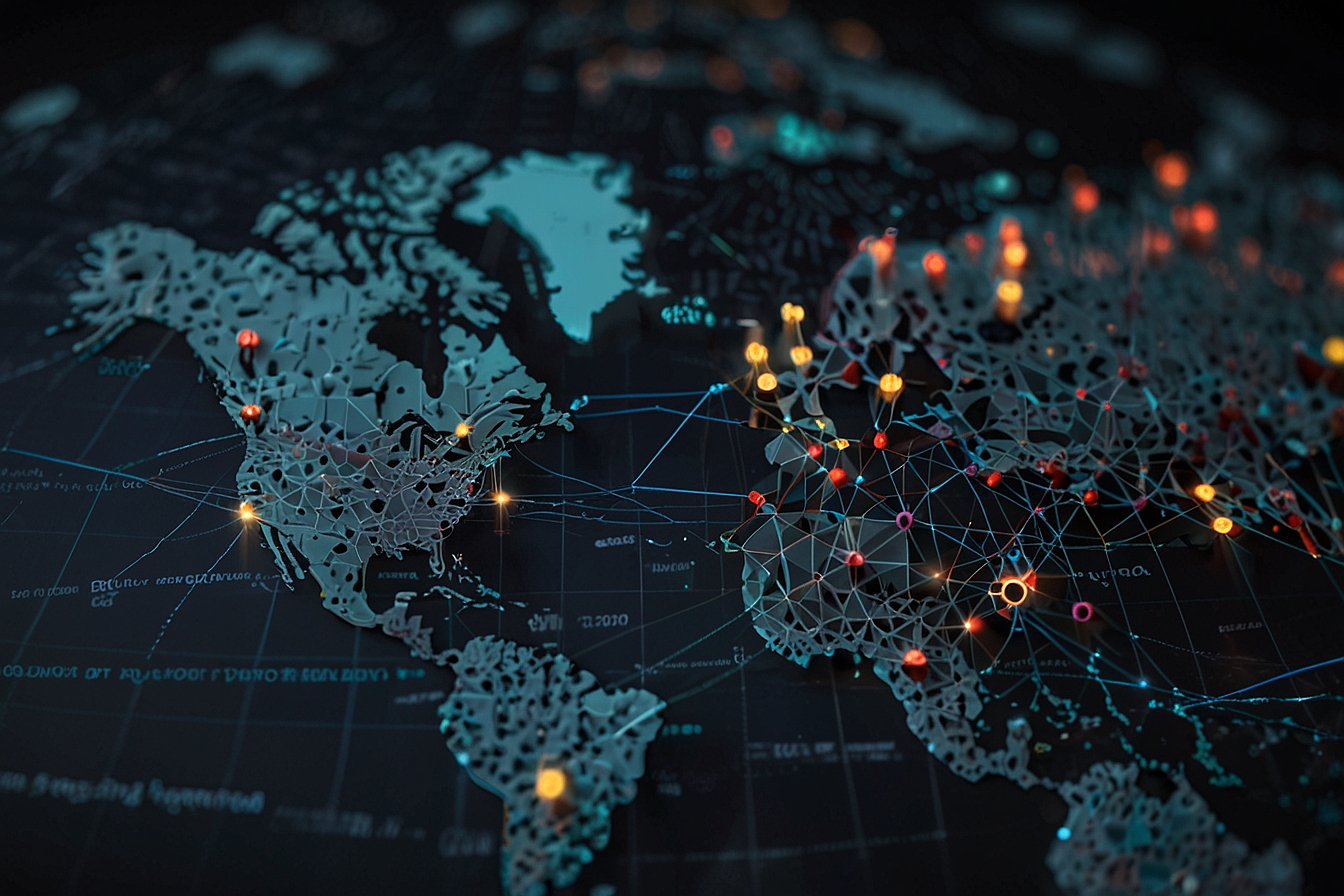
Graph-Based Fraud Detection: Using Relationship Mapping to Uncover Complex Money-Laundering Rings
Financial fraud has evolved. Gone are the days of isolated bad actors working alone. Today, money-laundering rings operate as highly sophisticated networks—layered, global, and designed explicitly to evade traditional detection systems. A single suspicious transaction might look normal in isolation. But when connected to dozens of others, a clear pattern of criminal activity emerges.
Graph-based fraud detection is the modern answer to this challenge. Instead of examining transactions one by one, it uses relationship mapping to reveal hidden connections between accounts, devices, payments, and people. This approach is uniquely effective at identifying complex money-laundering rings that would otherwise remain invisible.
This article explores how graph technology works, why it outperforms traditional methods, and how financial institutions, fintechs, and crypto platforms can deploy it to fight the latest generation of financial crime.
1. What Is Graph-Based Fraud Detection?
Beyond Flat Data
Traditional fraud detection treats data as rows in a table: transaction ID, amount, timestamp, sender, receiver. This is flat data. It cannot easily answer questions like: “Which accounts share a phone number?” or “How many hops connect this new customer to a known fraudster?”
Graph-based fraud detection models data as a network—nodes (entities) and edges (relationships). Nodes can represent bank accounts, email addresses, IP addresses, device IDs, or physical locations. Edges represent transactions, logins, shared devices, or common identifiers.
Keyword highlight: Graph-based fraud detection, relationship mapping, nodes and edges, network modeling, complex money-laundering rings.
How a Graph Differs from a Database
| Traditional Database | Graph Database |
|---|---|
| Slow joins across tables | Instant traversal of relationships |
| Requires predefined queries | Exploratory pattern matching |
| Hides indirect connections | Reveals multi-hop paths |
| Optimized for individual records | Optimized for connections |
For money laundering, connections are everything. A launderer might use ten shell companies, but if they all use the same mailing address, the graph reveals the ring instantly.
2. Why the Current Generation Needs Graph-Based Detection
The Rise of Organized Financial Crime
Current-generation money laundering is not amateur. It involves:
- Professional laundering networks selling services on the dark web
- Cryptocurrency mixers and tumblers obscuring transaction trails
- Synthetic identity rings using stolen and fabricated data
- Cross-border rapid layering moving funds through dozens of accounts in minutes
Traditional rule-based systems (e.g., “flag any transaction over $10,000”) are easily bypassed. Criminals simply split amounts or use multiple accounts. Graph-based fraud detection catches the pattern, not the individual transaction.
Keyword highlight: organized financial crime, cryptocurrency mixers, synthetic identity rings, cross-border layering.
Regulatory Pressure for Network Analysis
Regulators including FATF, FinCEN, and the European Banking Authority now explicitly recommend or require transaction network analysis for anti-money laundering (AML) programs. The days of relying solely on rule-based alerts are ending.
Real-Time Detection Expectations
Current-generation users expect instant fraud protection. A graph database can traverse millions of relationships in milliseconds, returning a risk score before a transaction is approved. This enables real-time blocking of laundering rings, not after-the-fact reporting.
3. Core Concepts: How Graph-Based Detection Works
Nodes: The Entities in Your Network
Every participant or artifact becomes a node. Common nodes in financial graphs:
- Account nodes (bank, crypto wallet, payment card)
- Customer nodes (individuals, companies)
- Device nodes (mobile device ID, computer fingerprint)
- Location nodes (IP address, GPS coordinates, mailing address)
- Transaction nodes (each payment as a separate node)
Keyword highlight: nodes, entities, financial graph, device fingerprinting, transaction nodes.
Edges: The Relationships That Connect
Edges define how nodes interact. Directed edges show flow (e.g., “Account A paid Account B”). Undirected edges show shared attributes (e.g., “Account A and Account B share a phone number”).
Types of edges in anti-money laundering:
- Transaction edges (amount, timestamp, currency)
- Ownership edges (customer owns account)
- Contact edges (shared email, phone, address)
- Login edges (device accessed account)
- Referral edges (who invited whom)
Paths and Hops
A path is a sequence of edges connecting two nodes. Hops count the steps. A two-hop path might be: Customer X → Account 1 → Transaction → Account 2 → Customer Y. If Customer X is a known fraudster, then Customer Y is only two hops away from criminal activity.
Keyword highlight: edges, paths, hops, shared attributes, known fraudster linkage.
Graph Algorithms for Fraud Detection
| Algorithm | Purpose |
|---|---|
| Community detection | Find tightly connected groups (likely laundering rings) |
| PageRank | Identify influential or central nodes |
| Shortest path | Find quickest connection between suspect and clean account |
| Loop detection | Uncover circular transactions (layering) |
| Similarity scoring | Find nodes with identical connection patterns |
4. Types of Money-Laundering Rings Graph Detection Excels At
A. Circular Laundering (Layering)
Criminals move money through multiple accounts in a loop to obscure origin. A simple loop: A → B → C → A. In flat data, each transaction looks normal. In a graph, the cycle is immediately visible.
Keyword highlight: circular laundering, layering, transaction cycles, loop detection.
B. Fan-Out and Fan-In Structures
A single source account pays dozens of accounts (fan-out), which eventually consolidate into a destination account (fan-in). Graph algorithms detect this convergent flow even if individual transaction amounts are small.
C. Synthetic Identity Rings
Fraudsters create fake identities using combinations of real and fabricated data. In a graph, multiple synthetic identities sharing the same phone number, address, or device fingerprint form a connected component—exposing the ring.
D. Smurfing (Structuring)
Large sums are split into many small transactions just under reporting thresholds. Graph detection links all small transactions to a single source account or beneficiary, revealing the aggregate flow.
Keyword highlight: fan-out fan-in, synthetic identity rings, smurfing, structuring detection, aggregate flow.
E. Mule Account Networks
Money mules receive illicit funds and forward them onward. In a graph, mule accounts appear as high-degree nodes (many incoming and outgoing transactions) often with unusual velocity (fast in-and-out). Community detection clusters mules with their handlers.
5. Graph vs. Traditional Fraud Detection: A Head-to-Head Comparison
| Feature | Rule-Based Systems | Machine Learning (Tabular) | Graph-Based |
|---|---|---|---|
| Sees single transactions | ✅ Yes | ✅ Yes | ✅ Yes |
| Sees indirect connections | ❌ No | ❌ No (without feature engineering) | ✅ Yes |
| Detects unknown rings | ❌ No | ⚠️ Limited | ✅ Yes (via community detection) |
| Works with little historical fraud data | ✅ Yes (rules) | ❌ No (needs labels) | ✅ Yes |
| Explains why something is fraud | ✅ Yes (rule) | ❌ Black box | ✅ Yes (visual path) |
| Real-time performance | ✅ Fast | ✅ Fast | ✅ Fast (with graph DB) |
Graph-based methods complement machine learning. The best modern systems combine all three: rules for known patterns, ML for scoring, and graphs for relationship discovery.
Keyword highlight: tabular machine learning, community detection, explainable fraud detection, hybrid AML systems.
6. Real-World Applications Across Financial Sectors
Banking and Payments
Banks deploy graph-based fraud detection to monitor real-time payment rails (e.g., FedNow, SEPA Instant, UPI). When a new transaction arrives, the graph instantly checks:
- Is the sender within two hops of a known suspicious account?
- Does this payment create a new cycle?
- Are multiple payees sharing an unusual common attribute?
Keyword highlight: real-time payment rails, instant payments fraud, banking graph analytics.
Cryptocurrency and DeFi
Blockchain is a natural graph. Every transaction is publicly visible. Graph-based analysis traces funds through mixers, cross-chain bridges, and DeFi protocols. Investigators identify which exchange addresses receive laundered funds and freeze them.
Example: A laundering ring uses a decentralized exchange (DEX) to swap stolen USDC for ETH, then bridges to another chain. Graph traversal follows the full path, linking the original theft to the final cash-out point.
Fintech and Neobanks
Digital-only banks use graph detection for onboarding fraud. New applicants are checked against graphs of known synthetic identities, shared devices, and circular referral bonuses. One compromised device linking five accounts exposes a ring instantly.
E-Commerce and Marketplaces
Online marketplaces detect seller collusion rings where fake accounts leave each other positive reviews or make fake purchases. Graphs reveal tightly connected seller communities engaging in coordinated manipulation.
Keyword highlight: cryptocurrency tracing, DeFi fraud, onboarding fraud, seller collusion, referral bonus abuse.
7. How Graph Databases Power Real-Time Detection
Popular Graph Technologies
| Tool | Type | Best For |
|---|---|---|
| Neo4j | Property graph | General fraud detection, visualizations |
| Apache Age | Extension for PostgreSQL | Teams already using Postgres |
| Amazon Neptune | Managed graph DB | Cloud-native deployments |
| TigerGraph | Native parallel graph | Very large scale (billions of nodes) |
| ArangoDB | Multi-model | Graphs + documents + search |
| Memgraph | In-memory streaming | Real-time, low-latency |
Query Example: Finding Two-Hop Connections
Using Cypher (Neo4j query language):
MATCH (fraudster:Account {risk: "high"})-[t:TRANSACTION*1..2]-(suspect:Account)
RETURN suspect.account_id, t
This returns any account within two transactions of a known risky account.
Keyword highlight: Neo4j, Apache Age, real-time graph queries, Cypher, hop traversal.
Streaming Graph Processing
Modern systems process transactions as they happen, updating the graph in milliseconds. When a new edge is added, algorithms recompute risk scores for affected nodes only (incremental processing), avoiding full recalculations.
8. Building a Graph-Based Fraud Detection System: A Roadmap
Phase 1: Data Integration
Gather all relevant entities and relationships:
- Transaction logs (sender, receiver, amount, time)
- Customer onboarding data (name, address, phone, email)
- Device fingerprints (from web or mobile sessions)
- IP geolocation data
- Historical fraud flags
Keyword highlight: data integration, entity resolution, device fingerprinting, fraud flags.
Phase 2: Graph Modeling
Design your graph schema:
- Define node types (Account, Customer, Device, Location, Transaction)
- Define edge types (OWNS, PAID, LOGGED_FROM, SHARED_ADDRESS)
- Add properties to edges (timestamp, amount, risk score)
Phase 3: Choose Algorithms
Deploy a set of detection algorithms:
- Community detection (Louvain, Label Propagation) – Find rings
- PageRank – Identify influential accounts
- Shortest path – Link suspect to clean entry points
- Loop detection – Find circular payments
Phase 4: Real-Time Scoring
Build an API that accepts a transaction and returns a graph-based risk score (e.g., 0–100). The score considers:
- Distance to known fraud nodes
- Unusual community density
- Velocity of new connections
Phase 5: Visualization for Investigators
Provide a graph visualization tool for human analysts. When an alert fires, the investigator sees the entire subgraph of connected entities—transforming a cryptic alert into a clear network diagram.
Keyword highlight: graph schema, community detection, risk scoring API, graph visualization, investigator tools.
9. Advantages Over Traditional Methods
Detects Unknown Patterns
Rule-based systems only catch what you already know to look for. Graph-based detection discovers emergent patterns—new laundering techniques that no one has seen before—by identifying unusual network structures.
Reduces False Positives
A single large transaction might trigger a false alert. But if that same account is also connected to a known mule network, the alert becomes genuine. Graph context dramatically reduces false positives compared to rules.
Provides Explainability
Regulators require explanations for account freezes. Graphs provide a visual, auditable path showing exactly why an account was flagged: “Account 456 is two hops from a confirmed laundering ring via shared device ID and three circular transactions.”
Keyword highlight: emergent pattern detection, false positive reduction, explainable AI, auditable paths.
Scales to Billions of Relationships
Modern graph databases handle billions of nodes and edges. Cloud-based solutions auto-scale. Real-time queries return results in under 100 milliseconds even at massive scale.
10. Common Challenges and Mitigations
Challenge 1: Data Quality and Entity Resolution
The same real-world entity might appear as “John Smith,” “J. Smith,” and “john.smith@email.com.” Without entity resolution, the graph creates separate nodes for the same person.
Solution: Use fuzzy matching, deterministic rules, and ML-based record linkage before graph ingestion.
Challenge 2: Computational Complexity
Traversing graphs can be expensive, especially multi-hop queries on billion-node graphs.
Solution: Use indexes on frequently traversed relationships, limit maximum hops (e.g., 3–4), and use approximate algorithms for community detection.
Keyword highlight: entity resolution, fuzzy matching, computational complexity, graph indexing.
Challenge 3: Cold Start Problem
New platforms have no historical fraud data. Graphs are initially empty.
Solution: Seed with known synthetic identity patterns, publicly available laundering indicators (e.g., OFAC sanctions lists), and use unsupervised community detection to find suspicious clusters without labels.
Challenge 4: Privacy Concerns
Graphs contain sensitive relationships that could expose non-fraudulent connections.
Solution: Encrypt node properties, implement role-based access controls (e.g., investigators see only flagged subgraphs), and use differential privacy for aggregated analytics.
11. The Future of Graph-Based Fraud Detection
Temporal Graphs
Instead of static snapshots, temporal graphs track how relationships evolve over time. An algorithm might flag: “This account has added ten new connections in the last hour—unusual growth pattern.”
Federated Graph Learning
Banks cannot share customer data directly due to privacy laws. Federated graph learning allows institutions to collaboratively train fraud detection models without exposing raw relationships—each bank learns patterns from the collective network.
Keyword highlight: temporal graphs, federated graph learning, privacy-preserving AML, collaborative fraud detection.
Integration with Generative AI
Large language models generate natural language alerts from graph patterns: “A newly formed community of 15 accounts exhibits circular payments totaling $2.3M over 72 hours, consistent with layering behavior.”
Real-Time Graph Neural Networks (GNNs)
Graph Neural Networks learn to embed entire subgraphs into risk scores. Unlike rule-based hop limits, GNNs automatically learn which connection patterns matter most. Deployed in streaming mode, they evaluate each transaction against its local graph neighborhood.
Cross-Institutional Fraud Graphs
Regulatory sandboxes and industry consortiums are building shared utility graphs where member institutions contribute hashed identifiers (not raw data). A laundering ring using accounts across five banks appears as a single connected component in the shared graph.
Keyword highlight: Graph Neural Networks, cross-institutional graphs, shared utility, real-time GNNs, consortium AML.
12. Getting Started: Practical First Steps
For Small Fintechs
- Start with a lightweight graph database (e.g., Neo4j AuraDB free tier).
- Import 30 days of transaction and login data.
- Run community detection on customer-device connections.
- Investigate the top five largest communities.
For Mid-Size Banks
- Deploy a graph-based alert triage system. Feed existing rule-based alerts into the graph to see connections between alerts.
- Build a visualization dashboard for investigators.
- Train analysts on graph traversal languages (Cypher, Gremlin).
For Large Enterprises
- Integrate graph detection into your real-time transaction scoring engine.
- Deploy a federated learning infrastructure across business units.
- Automate graph-based case management—when a node is flagged, automatically freeze all nodes within one hop.
Keyword highlight: lightweight graph database, alert triage, visualization dashboard, real-time scoring engine, automated case management.
13. Conclusion: See the Network, Stop the Ring
Money laundering is a network activity. Fighting it with non-network tools is like trying to understand a social media platform by reading one post at a time. Graph-based fraud detection aligns the solution with the problem: relationship mapping to identify complex money-laundering rings.
By modeling accounts, devices, transactions, and identities as a single interconnected graph, financial institutions can see what flat data hides—circular flows, synthetic identity clusters, mule networks, and emergent laundering patterns. The result is faster detection, fewer false positives, auditable explanations, and the ability to stop rings in real time before they cause damage.
The current generation of financial crime requires a current generation of defense. Graph technology is no longer a niche tool. It is the new baseline for any serious anti-money laundering program.
Final keyword highlight: Graph-based fraud detection, relationship mapping, complex money-laundering rings, real-time AML, network modeling, community detection, synthetic identity detection, circular layering, graph neural networks, cross-institutional fraud prevention.
Ready to map your risk? Start with a single use case—smurfing detection or synthetic identity onboarding. Build a small graph. Visualize one ring. Then expand. The connections are waiting to be seen.
https://www.youtube.com/@videotat-documentary
https://www.facebook.com/VideoTAT.1
https://www.pinterest.com/VideoTAT/